Showing posts with label NaBloPoMo. Show all posts

Thursday, November 05, 2015

What Not to Say: "God needed another angel/heaven needed them more than we do/God called them home"

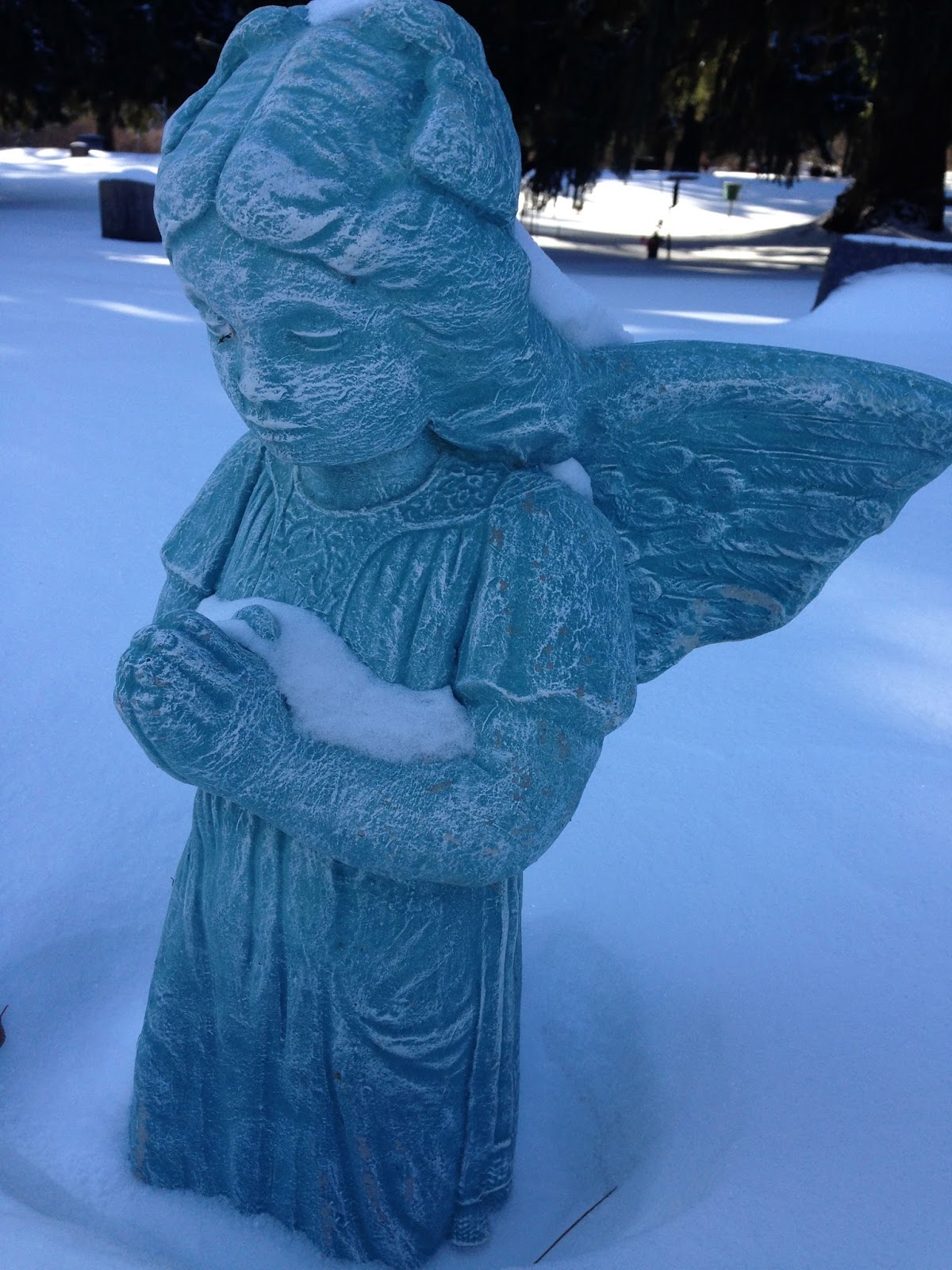
A.Hanson, Minnesota, 2014
Today's post in the series of "What Not to Say" looks at the phrase, "God needed another Angel" and many similar phrases including, "heaven needed them more than we do", "God called them home", "Jesus needed them."  This phrase is often used in the moments and days after a death, particularly a death that is unexpected or exceptionally tragic, like the death of a child or of a young adult.

In my work, I have found that parents who grieve the death of a child sometimes express comfort in thinking of their child nestled into the loving arms of a God in heaven. I support them in finding whatever means can bring them comfort in unimaginable moments of pain.

But linking the death of a beloved person to the activity of God by anyone else is problematic.  It places blame on on God for the death, and creates a god who takes people from their loved ones at will.  This particular platitude can absolutely ruin any sort of comfort that someone can find in their belief system in the arduous days, weeks and months to come. It opens a crack of disbelief in an already fragile grasp of meaning-making, and makes room for the intrusive thoughts of, "What is wrong with me that I don't belief God actually needed my child/sister/father?"

Saying, "God needed another angel" denies the very human needs of love, care, nurture, and relationship.  It implies that God's need for something (which to be brutally honest, we can never actually know, although God never NEEDS anything, that is why God is God) is greater than ours and that our needs should always be subservient to those of a temperamental deity off in the sky. This is crap theology.  Every single major world religion has precedent in their holy texts for arguing with their deities and for lamenting pain and suffering.

Finally this platitude ignores the experience of those who do not ascribe to theological systems that have a deity and an understanding of life after death. Or who are atheist or agnostic or have belief systems that are outside a very specific expression of Christianity.

Instead of saying, "Heaven needed them more than we do", say, "I can see how much you love them.  Tell me about your child/partner/parent."  Or share a story of why their life matters to you.

Or bring a damn casserole over and say, "bake at 350 degrees for 30 minutes."  That's infinitely more comforting than claiming God swooped in like some vulture and took someone's beloved.


Wednesday, November 04, 2015

What not to say: "Everything happens for a reason"

A.Hanson, Denver, 2011
I stumbled across this really excellent article the other day, ""Everything Doesn't Happen For a Reason" by Tim Lawrence. It articulates the philosophy behind my care in chaplaincy.  I spend nearly all of my work hours walking alongside people who are living the very worst days of their lives. There really are not words for these moments, so most of the time I just stand or sit quietly. My ministry is one of presence.

But there are things that well-meaning people say that cause more harm than good.  I should preface that my patients guide their own care.  If someone expresses the belief that their illness or suffering, or that of their loved ones, fits into a plan that is meaningful or provides hope, I would explore that system with them.  I would never dismantle structures of meaning for someone.  This series of posts, "what not to say" is directed towards those who wish to support those who are suffering.

Platitudes like "everything happens for a reason" are misguided attempts at support that are much more like self-soothing on the part of those who seek to assuage their own discomfort.

Placing suffering into some greater plan is an attempt to push back the deep paralyzing fear that a crisis could happen entirely randomly. If we admit that someone experienced an entirely undeserved and random event, the unspoken corollary is, "It could happen to me too."

The task of placing meaning onto a random event, to find some greater purpose in suffering, is ONLY for the person for whom the suffering belongs.

Let me repeat that, ONLY the person who is experiencing the rupture of the fibers of their world can place meaning for good onto their suffering. 

No clergy-person or well-meaning friend or family member can assign a greater purpose to suffering.  Suffering is never part of God's plan.  It is not about drawing someone closer to the divine or reminding them to trust in God or turn their lives over to a higher power.

Meaning can be found on the other side of suffering.  I know many families who have found purpose in advocating for organ donation or financial support for disease research or have indeed found that their experience of suffering encourages them to draw closer to the divine.

But I also know people and their families whose lives have been destroyed. Who never recover.  Who never find meaning in their suffering.

Not everything happens for a reason.  Sometimes shit just happens.   By saying, "Everything happens for a reason" we refuse to see the person who is suffering. We do not see the pain right in front of us, instead, we jump forward to some greater meaning at the expense of the very real person who is living that pain.

Instead of saying, "Everything happens for a reason," say, "I can't imagine what you must be feeling. Can I sit with you?" or "I see you."

Or better yet, don't say anything.  Just be.  That's what I do a lot of the time.

Tuesday, November 03, 2015

What did you want to be when you grow up?

A lot of the prompts that have been put forth by NaBloPoMo for the posts this month relate to thinking about the past.  Today I am thinking about what I wanted to be when I grew up.  I was never one of those kids who had a specific idea of what I wanted to be.  I had some vague ideas, like I wanted to help people and something to do with health care.  I have been lucky to have worked in several fields that allow me to care for people: human services, case management, nursing, parish ministry, and now chaplaincy.

I think I have the best job in the world.  I get to spend time with other people for a living.  My work as a chaplain frees me to care for the souls and emotions and minds of my patients. I actually get to be a PERSON for a living. The greatest qualification for my work is to use all of the emotional intelligence and mental intelligence that I have to meet another person right where they are. I have been a master's degree, an Mdiv, and have been prepared in a variety of ways for this work, including 1600 clinical hours and approval by my judicatory.  I am currently working towards board certification in chaplaincy, a standard for any discipline in healthcare.

I think I am dangerously close to becoming a grown-up.  I am into my thirties, I have several degrees, including a graduate degree, and I am self-sufficient. I am also thrilled to say that my vocation, chaplaincy, is what I want to be when I grow up.  What a gift.

Monday, November 02, 2015

NaBloPoMo November 2015

NaBloPoMo November 2015
A few years ago I participated in National Poetry Writing Month, and during the month of November I will be participating in National Blog Posting Month. This is a writer's discipline, and encourages me to reflect upon something each day and post it on my blog.  Additionally, I will be engaging with others who are also doing the same.